Syllabus: Geomagnetism and Space Weather
- Date
Course in the "Physics of the Earth and Atmosphere" master program.

Objectives
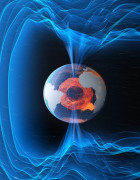
The course covers physics, origin and governing principles of planetary magnetic fields and their dynamics. Methods for analysis and interpretation of time-varying magnetic field will be elaborated. Students will be introduced to the field of space weather and space climate; and study the hazardous effects of geomagnetic storms on critical ground and space infrastructure.
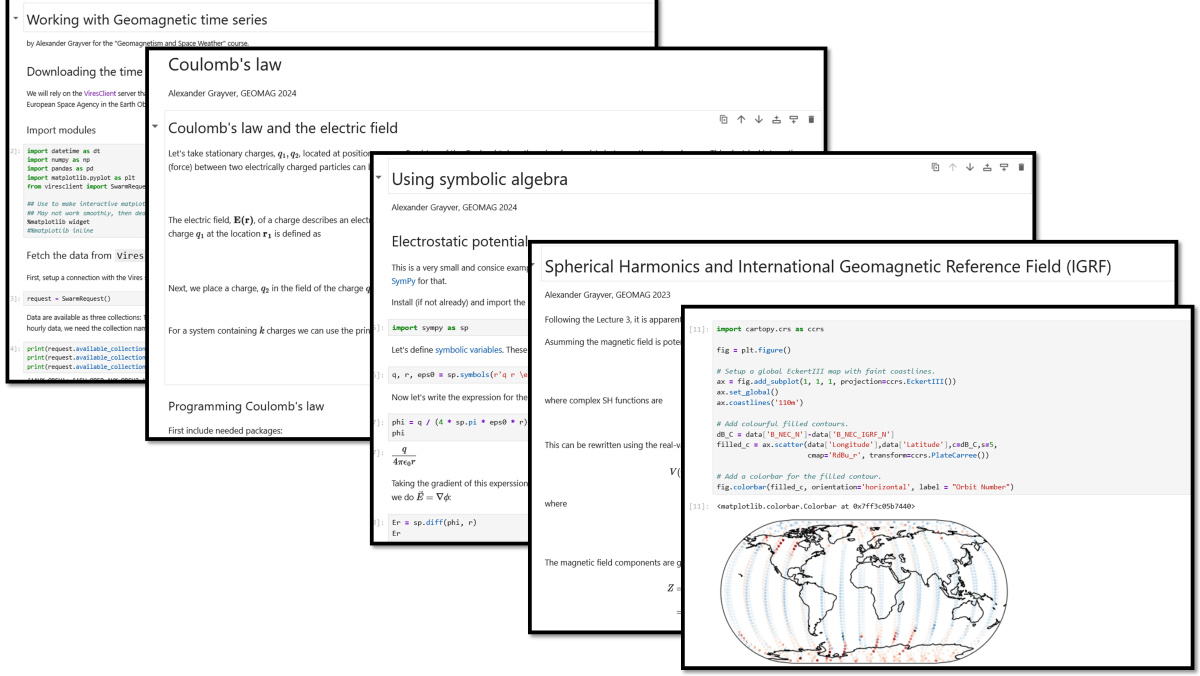
We will see how Earth's magnetic field is measured on surface and from satellites. A variety of applications, from Earth’s subsurface imaging to geomagnetic storm modelling and navigational drilling will be considered during lectures and hand-on practical Python-based exercises.
Acquired skills
Principles of Electromagnetism, Geomagnetism and vector field analysis
Analysis of geophysical time-series and multi-dimensional data
Fundamentals of Machine Learning and Statistical Analysis
Python/Jupyter programming skills
Presentation skills, critical assessment, and analysis of scientific work..
Module Content
Geomagnetic field: origin, history of science, spatiotemporal characteristics
Electromagnetism: governing principles, Maxwell’s equations
Electrical properties of rocks and minerals: conduction mechanisms
Magnetic properties of rocks and minerals: types of materials, Curie point
Earth’s Ionosphere and Magnetosphere
Space weather: introduction
Geomagnetic storms: modelling and forecast
Magnetic fields due to oceanic currents: motional induction
Basics of deep electromagnetic tomography of Earth’s interior
Measuring Earth’s magnetic field: satellite and ground observations
Data processing and time-series analysis of magnetic fields
Applications: georesource exploration, navigational drilling, tomography
Exercises (Python/Jupyter)
Determination of Earth’s magnetic field parameters using European Space Agency Satellite data
Machine-learning forecasting of a geomagnetic storm
Extraction of magnetic signals due to lunar ocean tide using multi-variate statistical methods
Time series analysis of space weather measurements
Linear inverse problem for magnetic susceptibility of rocks
Non-linear inverse problem for electromagnetic sounding of the mantle